Posts tagged horizons of the possible
 Six continents’ worth of static
Nate
:
When all you want is Friends (or even its Arabic equivalent), prepare to weed through Italian soaps, Iranian talk shows, the Pentagon channel, Egyptian poetry, Russian porn, Mecca 24/7, Italian porn, state-run news, Kurdish divas, soccer, fútbol, American rap on Arab MTV, Bollywood revels, false prophets from Holland, German business commentary. When you finally come to Courteney Cox and Jennifer Aniston, they’re dubbed in Japanese.
I suppose the price you pay for living in a country that doesn’t produce too much TV for its own good is that you’re forced to learn about the rest of the world. This learning shouldn’t be confused with CIA World Factbook-learning. It’s more like what you’d get from a good intercontinental love affair. At the very least, watching the satellite means being subjected to the fact that this planet is crowded and teeming with desires for every kind of stardom. Amidst them all, our little languages and preferences are the tiniest of snowflakes falling in six continents’ worth of static.


 The new old cartography
Nate
:
Geography | How the new cartography is like mapmaking in the Middle Ages: Today’s maps are “geographically accurate beyond the dreams of a medieval mind,” yet they’re still, perhaps more than ever, vehicles for representing the world’s geography as the mapmaker idiosyncratically interprets it — never mind getting from point A to point B. [Boston Globe]
 Allegro non sequitur
Nate
: Fighting time with marble
Nate
:Stone-cutters fighting time with marble, you foredefeated Challengers of oblivion Eat cynical earnings, knowing rock splits, records fall down, The square-limbed Roman letters Scale in the thaws, wear in the rain. The poet as well Builds his monument mockingly; For man will be blotted out, the blithe earth die, the brave sun Die blind and blacken to the heart: Yet stones have stood for a thousand years, and pained thoughts found The honey of peace in old poems.
Rich objects
Nate
: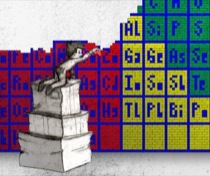
Science is fueled by passion, a passion that is often attached to the world of objects much as the artist is attached to his paints, the poet to her words. From my first days at the Massachusetts Institute of Technology in 1976, I saw this passion for objects everywhere. My students and colleagues told how they were drawn into science by the physics of sand castles, by playing with soap bubbles, by the mesmerizing power of a crystal radio.
Since this was the early days of computer culture, there was also talk of new objects. Some people identified with their computers, experiencing these machines as extensions of themselves. For them, computers were useful for thinking about larger questions, questions of determinism and free will, of mind and mechanism ...
Objects don’t nudge every child toward science, but for some, a rich object world is the best way to give science a chance. Given the opportunity, children will make intimate connections, connections they must construct on their own ...
If we attend to young scientists’ romance with objects, we are encouraged to make children comfortable with the idea that falling in love with things is part of what we expect of them. We are encouraged to introduce the periodic table as poetry and LEGOs as a form of art.
When libraries shine
Nate
:The Boston Public Library is no different. New library cards are up 32.7 percent from July to November of 2008, compared with the same period in 2007. Visits are up 13 percent, from 1.4 million visits to 1.6 million. Checkouts of books, CDs, and DVDs are up 7.2 percent overall over the last fiscal year. More telling is that checkouts have soared between 27 percent and 37 percent at the Egleston Square, Fields Corner, Jamaica Plain, and Orient Heights branches.
New BPL president Amy Ryan said a baby story program at the Copley library has grown from fluctuating between 60 and 80 families to well over 100. Monthly visits to a free Internet homework tutoring service have doubled from 300 to 600. She said anecdotal reports indicate a spike in people using branch libraries to research new careers or returning to school. This is despite the BPL probably facing cuts, too.
“Libraries are unfortunately used to this,” Ryan said. “But the essential role of the library cannot be duplicated in anybody’s home, when you consider the combination of manuals, books, and librarian expertise,” Ryan said. “In down economic times, families aren’t going out to spend a lot of money on books and movies. This is when the branches can shine as a community gathering place and at a time when people are seeking answers to life improvement.”
Snark is what you make of it
But all that said, I want to go back to the point that this is a useless argument. Here’s my prediction: not one person in a thousand is going to be confronted with a statement whose core idea they agree with and say, Yep, that’s too snarky. They’ll either say along with Sternbergh that that’s good snark or (what amounts to the same thing) they’ll say it’s not snark at all but rather legitimate irony or sarcasm which the target of the criticism richly deserves. When faced with actual examples of critical language, almost everyone will approve of that critical languge if it’s directed against their (political, social, artistic, religious) enemies and disapprove of it if it’s directed against something or someone they approve of. Democrats will lament Republican snark, Republicans will lament Democratic snark, world without end. Why even bother having this conversation?
I’ll confine myself to this one statement: whether snark is ever a good thing or not depends on what you want to achieve. If you want to buld solidarity among people who already share a set of core convictions, or if you just want to blow off your own built-up steam, then snark might be a good thing. If you want to find ways to get people who disagree with each other to come to some mutual understanding, and perhaps even agreement . . . not so much.
Nate
:When a modern Japanese family sits round the supper table eathing their bowls of Japanese-grown rice, they are not simply indulging a gastronomic preference for short-grain and slightly sticky Japonica rice over long-grain Indica rice from Thailand. They are eating and absorbing a tradition—in the sense of an invented and reinvented past. While the television beside the dining table pours out a stream of images of the here-and-now, of an urbanized, capitalist, and thoroughly internationalized Japan, each mouthful of rice offers communion with eternal and untainted Japanese values, with a rural world of simplicity and purity, inhabited by peasants tending tiny green farms in harmony with nature and ruled over by the emperor, descendant of the Sun Goddess, who plants and harvests rice himself each year in a special sacred plot. Simple peasant rice farmers are as marginal in contemporary Japan as hand-spinners are in India, but the small rice farm, like the swadeshi [homespun-style cloth] industry, lives on as a powerful symbol.
Objectified
Andy
:Nate
:
Tool use is rare in wild animals, but of widespread interest because of its relationship to animal cognition, social learning and culture. Despite such attention, quantifying the costs and benefits of tool use has been difficult, largely because if tool use occurs, all population members typically exhibit the behavior. In Shark Bay, Australia, only a subset of the bottlenose dolphin population uses marine sponges as tools, providing an opportunity to assess both proximate and ultimate costs and benefits and document patterns of transmission. We compared sponge-carrying (sponger) females to non-sponge-carrying (non-sponger) females and show that spongers were more solitary, spent more time in deep water channel habitats, dived for longer durations, and devoted more time to foraging than non-spongers; and, even with these potential proximate costs, calving success of sponger females was not significantly different from non-spongers. We also show a clear female-bias in the ontogeny of sponging. With a solitary lifestyle, specialization, and high foraging demands, spongers used tools more than any non-human animal. We suggest that the ecological, social, and developmental mechanisms involved likely (1) help explain the high intrapopulation variation in female behaviour, (2) indicate tradeoffs (e.g., time allocation) between ecological and social factors and, (3) constrain the spread of this innovation to primarily vertical transmission.
In search of the Easy Fret
Nate
:Music | “The success of Guitar Hero means that the onus is now on the manufacturers of ‘real’ guitars to make them easier,” a blogger says. “Why are they still making guitars with ‘real’ strings that are difficult and boring to learn how to play and really make your fingers hurt? What is the point?” Are musicians to be protected like some sort of medieval guild? [Guardian]


Nate
:Africa and missionaries, pt. 1
Nate
:Now a confirmed atheist, I’ve become convinced of the enormous contribution that Christian evangelism makes in Africa: sharply distinct from the work of secular NGOs, government projects and international aid efforts. These alone will not do. Education and training alone will not do. In Africa Christianity changes people’s hearts. It brings a spiritual transformation. The rebirth is real. The change is good.
I used to avoid this truth by applauding - as you can - the practical work of mission churches in Africa. It’s a pity, I would say, that salvation is part of the package, but Christians black and white, working in Africa, do heal the sick, do teach people to read and write; and only the severest kind of secularist could see a mission hospital or school and say the world would be better without it. I would allow that if faith was needed to motivate missionaries to help, then, fine: but what counted was the help, not the faith.
But this doesn’t fit the facts. Faith does more than support the missionary; it is also transferred to his flock. This is the effect that matters so immensely, and which I cannot help observing.
Africa and missionaries, pt. 2
Nate
:Majestic in a green chasuble, Father Ibemere delivered his homily strolling up and down the aisle. When it was time to distribute the eucharist, he bent down to give communion to a man he knew was too ill to stand.
After the Mass, however, one member of the congregation, Virginia Ballard, gestured toward the Nigerian priest and confided in Father Venters, “I can’t understand what he said, but he’s a sweet young man.”
Mrs. Ballard went on to praise Father Ibemere’s knowledge of the Bible, his capacity to remember the names of congregants, his willingness to teach the Americans about his home in Nigeria. “He is a holy man,” she concluded, “and we are honored to have him.”
Lazy futures
Nate
:Why is the dystopian future always literally dark? Why is it always raining or overcast? Why is the architecture always a mix of hyper-modernism, brutalism and squatter slum? Why is the politics always so transparently totalitarian, so fascist-plus-rebels? Why is it so retro and abstract?
Why doesn’t the dystopian vision ever include sunshine and children playing in its ruins? Why does it not include the constant, untiring efforts of most people to do what they can with what they have to improve their situations? Why are most people in the dystopian future always powerless to change anything? I could go on, but you get the point.
The biggest problem with dystopian fiction is not its pessimism. I do think there’s a serious issue about who’s interests are best served by making people fear the future, but I think the biggest problem with most dystopian fiction is its laziness and derivative quality. Lazy futures act like visionary static, crackling and dirtying the signal-to-noise ratio, making it harder not only for truly insightful futures to be found, but corrupting the ability of normal people to see why those visions are worth understanding.
The Rosa Parks of blogs
Nate
:The Aquaman of the Democratic Party
The Dr. J of murdering people
The Ludwig Wittgenstein of trash TV
The Ned Flanders of the gay blogosphere
The Mae West of fowl
The Sydney Bristow of Miss Hosie’s fifth grade
The Brangelina of the lion kingdom
The Ron Burgundy of the three-feet and under set
The New Jersey of the Batman dimension
The Tina Fey of crazed retrograde gender pundits
The Bea Arthur of diet sodas
The Dr. Doom of my teenage existence
The Nancy Reagan of giant mutant cockroaches
The Mini-me of oscillating tools
The James Brown of neurotransmitters
The Sarah Silverman of operating systems
Like sentiment, which has been called unearned emotion, the new irony is a form of unearned skepticism. It creates nothing of its own but waits to ambush moral purpose, to play havoc with common sense, to deny reason its moment.
—Benjamin Barber, "The Price of Irony"
Adieu, S.U.V.’s
Nate
:Here is the puzzling thing. The apparent cause of death for S.U.V.’s was high gas prices. Doesn’t that mean that with low gas prices S.U.V. sales should come back to life? I can think of a few reasons why that might not be the case:
1) Consumers think that the low current gas prices are temporary, and in general gas prices will be high in the future. Thus, they don’t want to get stuck with a vehicle that gets poor gas mileage. The question this raises is why consumers were so sure six months ago that gas prices were going to be high forever (which turned out to be wrong), but don’t believe now that gas prices will stay low.
2) The uncertainty of fluctuating gas prices takes the fun out of owning an S.U.V. Even if gas prices won’t be that high on average, it is so unpleasant to have an S.U.V. when gas prices are high that people don’t want to have them if gas prices are volatile. This explanation seems kind of dumb to me, but maybe it is possible.
3) When gas prices got high, it became uncool to own an S.U.V. Perhaps the process for going from cool to uncool is not easily reversible. Once something is uncool, it remains uncool for a long time, even when the forces that caused it to be uncool recede. This might explain why the demand for pickup trucks remains strong, even as S.U.V.’s fade. Somehow the spike in gas prices didn’t make pickup trucks uncool in the same way as S.U.V.’s. Similarly, minivans have never been cool (or at least not for a long time); so if this explanation is right, minivan sales should stay strong.
Adieu, Polaroids
Nate
: